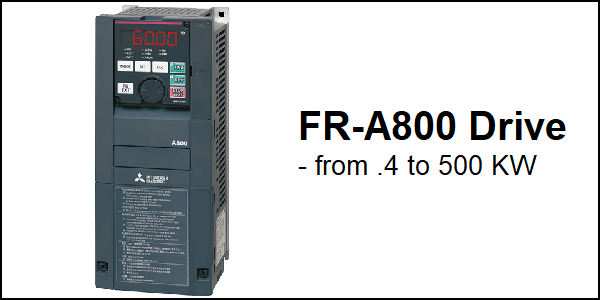
Faults & Alarms
Search from below list for FR-A800 drive faults & alarms:
| Fault Code | Cause & Solution |
|---|---|
| HOLD Operation panel lock | Cause: Operation lock mode is set. Operation other than STOP/RESET is invalid. Solution: – Press MODE for 2s to release lock. |
| LOCD Password locked | Cause: Password function is active. Display and setting of parameter is restricted. Solution: – Enter the password in Pr. 297 Password lock/unlock to unlock the password function before operating. |
| Er1 Write disable error | Cause: – You attempted to make parameter setting when Pr. 77 Parameter write selection has been set to disable parameter write. – Frequency jump setting range overlapped. – Adjustable 5 points V/F settings overlapped – The PU and inverter cannot make normal communication Solution: – Check the setting of Pr. 77 Parameter write selection – Check the settings of Pr. 31 to 36 (frequency jump). – Check the settings of Pr. 100 to Pr. 109 (adjustable 5 points V/F). – Check the connection of the PU and inverter. |
| Er2 Write error during operation | Cause: Parameter write was attempted while Pr.77 Parameter write selection = “0”. Check point: – Check the Pr. 77 setting. – Check that the inverter is not operating. Solution: – Set “2” in Pr. 77. – After stopping operation, make parameter setting. |
| Er3 Calibration error | Cause: Analog input bias and gain calibration values are too close. Check point: – Check the settings of C3, C4, C6 and C7 (calibration functions). |
| Er4 Mode designation error | Cause: – Appears if a parameter setting is attempted in the External or NET operation mode with Pr. 77 ≠ “2”. – Appears if a parameter setting is attempted when the command source is not at the operation panel. (FR- DU07). Check point: – Check that operation mode is “PU operation mode”. – Check the Pr. 77 setting. – Check the Pr. 551 setting. Solution: – After setting the operation mode to the “PU operation mode”, make parameter setting. – After setting Pr. 77 = “2”, make parameter setting. – Set Pr.551 = “2 (initial value)”. |
| Er8 USB memory device operation error | Cause: – An operation command was given during the USB memory device operation. – A copy operation (writing) was performed while the PLC function was in the RUN state. – A copy operation was attempted for a password locked project. Check point: – Check if the USB memory device is operating. – Check if the PLC function is in the RUN state. – Check if the project data is locked with a password. Solution: – Perform the operation after the USB memory device operation is completed. – Stop the PLC function. – Unlock the password of the project data using FR Configurator2. |
| rE1 Parameter read error | Cause: – A failure has occurred at the operation panel side EEPROM while reading the copied parameters. – A failure has occurred in the USB memory device while copying the parameters or reading the PLC function project data. Solution: – Perform parameter copy again. – Perform PLC function project data copy again. – The USB memory device may be faulty. Replace the USB memory device. – The operation panel (FR-DU08) may be faulty. |
| rE2 Parameter write error | Cause: – Parameter copy from the operation panel to the inverter was attempted during operation. – A failure has occurred at the operation panel side EEPROM while writing the copied parameters. – A failure has occurred in the USB memory device while writing the copied parameters or PLC function project data. Check point: – Check that the inverter is stopped. Solution: – After stopping the operation, perform parameter copy again. – The operation panel (FR-DU08) may be faulty. – Perform parameter copy or PLC project data copy again. – The USB memory device may be faulty. Replace the USB memory device. |
| rE3 Parameter verification error | Cause: – The data in the inverter are different from the data in the operation panel. – A failure has occurred at the operation panel side EEPROM during parameter verification. – A failure has occurred in the USB memory device during parameter verification. – The data in the inverter are different from the data in the USB memory device or the personal computer (FR Configurator2). Check point: – Check the parameter setting of the source inverter against the setting of the destination inverter. Solution: – Continue the verification by SET button pressing . – Perform parameter verification again. – The operation panel (FR-DU08) may be faulty. – The USB memory device may be faulty. Replace the USB memory device. – Verify the PLC function project data again. |
| rE4 Model error | Cause: – The series of the source inverter used to copy or verify parameters is not the same as the target inverter. – The operation panel data was incorrect when attempting to verify parameters or copy parameters from the operation panel to the inverter. Check point: – Check that the source inverter being used to verify or copy parameters is the same series as the target inverter. – Check that the copying of parameters was not interrupted due to a loss of power to the inverter or the operation panel being disconnected. Solution: – Use the same model (FR-A800 series) for parameter copy and verification. ·- Perform parameter copy read again. |
| rE5 File error | Cause: – The data in the USB memory device may be damaged. Solution: – Delete the copy file in the USB memory device and perform parameter copy again. |
| rE6 File error | Cause: – The parameter copy file in the USB memory device cannot be recognized. – An error has occurred in the file system during transfer of the PLC function data or writing to RAM. Solution: – Perform parameter copy again. – Copy the PLC function project data again. |
| rE7 File quantity error | Cause: A parameter copy was attempted to the USB memory device in which the copy files from 001 to 099 had already been saved. Check point: – Check if the number of copy files in the USB memory device has reached 99. Solution: – Delete the copy file in the USB memory device and perform parameter copy again. |
| rE8 No PLC function project file | Cause: The specified PLC function project file does not exist in the USB memory device. Check point: – Check that the file exists in the USB memory device. – Check that the folder name and the file name in the USB memory device is correct. Solution: – The data in the USB memory device may be damaged. |
| Err. | Cause: – The RES signal is on – The PU and inverter cannot make normal communication (contact fault of the connector) – When the voltage drops in the inverter’s input side. – When the control circuit power (R1/L11, S1/L21) and the main circuit power (R/L1, S/L2, T/L3) are connected to a separate power, it may appear at turning ON of the main circuit. It is not a fault. Solution: – Turn OFF the RES signal. – Check the connection of the PU and inverter. – Check the voltage on the inverter’s input side. |
| OL Stall prevention (overcurrent) | Cause: – During acceleration: When the output current (output torque during Real sensorless vector control or vector control) of the inverter exceeds the stall prevention operation level (Pr. 22 Stall prevention operation level, etc.), this function stops the increase in frequency until the overload current decreases to prevent the inverter from resulting in overcurrent trip. When the overload current has decreased below stall prevention operation level, this function increases the frequency again. – During constant speed operation: When the output current (output torque during Real sensorless vector control or vector control) of the inverter exceeds the stall prevention operation level (Pr. 22 Stall prevention operation level, etc.), this function reduces frequency until the overload current decreases to prevent the inverter from resulting in overcurrent trip. When the overload current has decreased below stall prevention operation level, this function increases the frequency up to the set value. – During deceleration: When the output current (output torque during Real sensorless vector control or vector control) of the inverter exceeds the stall prevention operation level (Pr. 22 Stall prevention operation level, etc.), this function stops the decrease in frequency until the overload current decreases to prevent the inverter from resulting in overcurrent trip. When the overload current has decreased below stall prevention operation level, this function decreases the frequency again. Check point: – Check that the Pr. 0 Torque boost setting is not too large. – Check that the Pr. 7 Acceleration time and Pr. 8 Deceleration time settings are not too small. – Check that the load is not too heavy. – Are there any failure in peripheral devices? – Check that the Pr. 13 Starting frequency is not too large. – Check the motor for use under overload. – Check that Pr. 22 Stall prevention operation level is appropriate. Solution: – Increase or decrease the Pr. 0 Torque boost value 1% by 1% and check the motor status.146. – Set a larger value in Pr. 7 Acceleration time and Pr. 8 Deceleration time. – Reduce the load weight. – Try Advanced magnetic flux vector control, Real sensorless vector control or vector control. – Change the Pr. 14 Load pattern selection setting. – Set stall prevention operation current in Pr. 22 Stall prevention operation level. (The initial value is 150%.) The acceleration/deceleration time may change. Increase the stall prevention operation level with Pr. 22 Stall prevention operation level, or disable stall prevention with Pr. 156 Stall prevention operation selection. (Use Pr. 156 to set either operation continued or not at OL operation.) |
| oL Stall prevention (overvoltage) | Cause: During deceleration: – If the regenerative energy of the motor becomes excessive and exceeds the regenerative energy consumption capability, this function stops the decrease in frequency to prevent overvoltage trip. As soon as the regenerative energy has decreased, deceleration resumes. – If the regenerative energy of the motor becomes excessive when regeneration avoidance function is selected (Pr. 882 = 1), this function increases the speed to prevent overvoltage trip. Check point: – Check for sudden speed reduction. – Regeneration avoidance function (Pr. 882 to Pr. 886) is being used? Solution: – The deceleration time may change. Increase the deceleration time using Pr. 8 Deceleration time. |
| RB Regenerative brake pre-alarm | Cause: Appears if the regenerative brake duty reaches or exceeds 85% of the Pr. 70 Special regenerative brake duty value. When the setting of Pr. 70 Special regenerative brake duty is the initial value (Pr. 70 = “0”), this warning does not occur. If the regenerative brake duty reaches 100%, a regenerative overvoltage (E.OV_) occurs. – The RBP signal can be simultaneously output with the [RB] display. For the terminal used for the RBP signal output, assign the function by setting “7” (positive logic) or “107” (negative logic) in any of Pr. 190 to Pr. 196 (output terminal function selection). Check point: – Check that the brake resistor duty is not high. – Check that the Pr. 30 Regenerative function selection and Pr. 70 Special regenerative brake duty values are correct. Solution: – Increase the deceleration time. – Check the Pr. 30 Regenerative function selection and Pr. 70 Special regenerative brake duty values. |
| TH Electronic thermal relay function pre-alarm | Cause: Appears if the cumulative value of the electronic thermal O/L relay reaches or exceeds 85% of the preset level of Pr.9 Electronic thermal O/L relay. If the specified value is reached, the protection circuit is activated to shut off the inverter output. Check point: – Check for large load or sudden acceleration. – Is the Pr. 9 Electronic thermal O/L relay setting is appropriate? Solution: – Reduce the load weight or the number of operation times. – Set an appropriate value in Pr. 9 Electronic thermal O/L relay. |
| PS/P5 PU stop | Cause: Stop with STOP/RESET button of the PU is set in Pr. 75 Reset selection/disconnected PU detection/PU stop selection. Check point: – Check for a stop made by pressing STOP/RESET button of the operation panel. Check for whether the X92 signal is OFF. Solution: – Turn the start signal OFF and release with PU/EXT button. Turn ON the X92 signal and OFF the start signal for release. |
| SL Speed limit indication (output during speed limit) | Cause: Output if the speed limit level is exceeded during torque control. Check point: – Check that the torque command is not larger than required. – Check that the speed limit level is not low. Solution: – Decrease the torque command. – Increase the speed limit level. |
| CP Parameter copy | Cause: Appears when parameter copy is performed between the FR-A820-03160(55K) or lower / FR-A840-01800(55K) or lower inverters and the FR-A820-03800(75K) or higher / FR-A840-02160(75K) or higher inverters. Check point: – Resetting of Pr.9, Pr.30, Pr.51, Pr.56, Pr.57, Pr.61, Pr.70, Pr.72, Pr.80, Pr.82, Pr.90 to Pr.94, Pr.453, Pr.455, Pr.458 to Pr.462, Pr.557, Pr.859, Pr.860, and Pr.893 is necessary. Solution: – Set the initial value in Pr.989 Parameter copy alarm release. |
| SA Safety stop | Cause: Appears when safety stop function is activated (during output shutoff). (Refer to page 83.) Check point: – Check if an emergency stop device is activated. – Check if the shorting wire between S1 and PC or between S2 and PC is disconnected when not using the safety stop function. Solution: – An emergency stop device is active when using the safety stop function. Identify the cause of emergency stop, ensure the safety and restart the system. – When not using the safety stop function, short across terminals S1 and PC and across S2 and PC with shorting wire for the inverter to run. – If “SA” is indicated when wires across S1 and SIC and across S2 and SIC are both conducted while using the safety stop function (drive enabled), internal failure might be the cause. Check the wiring of terminals S1, S2, and SIC and contact your sales representative if the wiring has no fault. |
| MT1 to MT3 Maintenance signal output | Cause: Appears when the inverter’s cumulative energization time reaches or exceeds the parameter set value. Set the time until the MT is displayed using Pr.504 Maintenance timer 1 warning output set time (MT1), Pr.687 Maintenance timer 2 warning output set time (MT2), and Pr.689 Maintenance timer 3 warning output set time (MT3). MT does not appear when the settings of Pr.504, Pr.687, and Pr.689 are initial values (9999). Check point: – The set time of maintenance timer has been exceeded. Solution: – Take appropriate countermeasures according to the purpose of the maintenance timer setting. Setting “0” in Pr.503 Maintenance timer 1, Pr.686 Maintenance timer 2, and Pr.688 Maintenance timer 3 clears the indication. |
| UF USB host error | Cause: Appears when an excessive current flows into the USB A connector. Check point: – Check if a USB device other than a USB memory device is connected to the USB A connector. Solution: – If a device other than a USB memory device is connected to the USB A connector, remove the device. – Setting Pr.1049 USB host reset = “1” or inverter reset clears the UF indication. |
| HP1, HP2 & HP3 Home position return error | Cause: Appears when an error occurs during the home position return operation under position control. Check point: – Identify the cause of the error occurrence. Solution: – Check the parameter setting, and check that the input signal is correct. |
| CF Continuous operation during communication fault | Cause: Appears when the operation continues while an error is occurring in the communication line or communication option (when Pr.502 = “4”). Check point: – Check for a break in the communication cable. – Check for communication option faults. Solution: – Check the connection of communication cable. – Replace the communication option. |
| ED Emergency drive in operation | Cause: Appears during emergency drive operation. Check point: – Emergency drive operation is performed by turning ON X84 signal. Solution: – The display is cleared when the emergency drive operation ends. |
| LDF Load fault warning | Cause: Appears when the load is deviated from the detection width set in Pr.1488 Upper limit warning detection width or Pr.1489 Lower limit warning detection width. Check point: – Check if too much load is applied to the equipment, or if the load is too light. – Check that the load characteristics settings are correct. Solution: – Inspect the equipment. – Set the load characteristics (Pr.1481 to Pr.1487) correctly. |
| FN Fan alarm | Cause: For the inverter that contains a cooling fan, FN appears on the operation panel when the cooling fan stops due to a fault, low rotation speed, or different operation from the setting of Pr.244 Cooling fan operation selection. Check point: – When the cooling fan is replaced, check that the fan is not installed upside down. – Check the cooling fan for a failure. Solution: – Check for fan fault. Install the fan correctly. |
| FN2 Internal fan alarm (IP55 compatible models only) | Cause: FN2 appears on the operation panel when the internal air circulation fan stops due to a fault or low rotation speed. Check point: – Check the internal air circulation fan for a failure. Solution: – The fan may be faulty. |
| E.OC1 Overcurrent trip during acceleration | Cause: When the inverter output current reaches or exceeds approximately 235% *1 of the rated current during acceleration, the protection circuit is activated and the inverter output is shut off. Check point: – Check for sudden speed acceleration. – Check if the downward acceleration time is too long in a lift application. – Check for output short-circuit. – Check that the Pr.3 Base frequency setting is not 60 Hz when the motor rated frequency is 50 Hz. – Check if the stall prevention operation level is set too high. Check if the fast-response current limit operation is disabled. – Check that the regenerative driving is not performed frequently. (Check if the output voltage becomes larger than the V/F reference voltage at regenerative driving and overcurrent occurs due to increase in the motor current.) – Check that the power supply for RS-485 terminal is not shorted (under Vector control). – Check that the encoder wiring and the specifications (encoder power supply, resolution, differential/ complementary) are correct. Check also that the motor wiring (U, V, W) is correct (under Vector control). – Check that the rotation direction is not switched from forward to reverse rotation (or from reverse to forward) during torque control under Real sensorless vector control. – Check that the inverter capacity matches with the motor capacity. (PM sensorless vector control) – Check if a start command is given to the inverter while the motor is coasting. (PM sensorless vector control) – Check the I/O terminal status (of terminals Y67, MRS, S1, and S2) with FR Configurator2 to check if the inverter has restarted the motor after output shutoff due to power failure, undervoltage, the MRS signal, or the safety stop function. Solutions: – Set the acceleration time longer. (Shorten the downward acceleration time of the lift.) – If “E.OC1” always appears at start, disconnect the motor once and restart the inverter. – Check the wiring to make sure that output short circuit does not occur. – Set 50 Hz in Pr.3 Base frequency. – Lower the stall prevention operation level. Activate the fast-response current limit operation. – Set the base voltage (rated voltage of the motor, etc.) in Pr.19 Base frequency voltage. – Check RS-485 terminal connection (under Vector control). – Check the wiring and specifications of the encoder and the motor. Perform the setting according to the specifications of the encoder and the motor (under vector control). – Prevent the motor from switching the rotation direction from forward to reverse (or from reverse to forward) during torque control under Real sensorless vector control. – Choose inverter and motor capacities that match. (PM sensorless vector control) – Input a start command after the motor stops. Alternatively, use the automatic restart after instantaneous power failure/flying start function. – Remove the cause of output shutoff. (Check the power supply, and terminals MRS, S1, and S2.) |
| E.OC2 Overcurrent trip during constant speed | Cause: When the inverter output current reaches or exceeds approximately 235% of the rated current during constant speed operation, the protective circuit is activated to stop the inverter output. Check point: – Check for sudden load change. – Check for output short circuit. – Check if the stall prevention operation level is set too high. – Check if the fast-response current limit operation is disabled. – Check that the power supply for RS-485 terminal is not shorted. (under vector control) – Check that the rotation direction is not switched from forward to reverse rotation (or from reverse to forward) during torque control under Real sensorless vector control. Solutions: – Keep load stable. – Check the wiring to make sure that output short circuit does not occur. – Lower the setting of stall prevention operation level. – Activate the fast-response current limit operation. – Check RS-485 terminal connection. (under vector control) – Prevent the motor from switching the rotation direction from forward to reverse (or from reverse to forward) during torque control under Real sensorless vector control. |
| E.OC3 Overcurrent trip during deceleration or stop | Cause: When the inverter output current reaches or exceeds approximately 235% of the rated inverter current during deceleration (other than acceleration or constant speed), the protective circuit is activated to stop the inverter output. Check point: – Check for sudden speed reduction. – Check for output short circuit. – Check for too fast operation of the motor’s mechanical brake. – Check if the stall prevention operation level is set too high. – Check if the fast-response current limit operation is disabled. – Check that the power supply for RS-485 terminal is not shorted. (under vector control) – Check that the rotation direction is not switched from forward to reverse rotation (or from reverse to forward) during torque control under Real sensorless vector control. Solutions: – Increase the deceleration time. – Check the wiring to make sure that output short circuit does not occur. – Check the mechanical brake operation. – Lower the setting of stall prevention operation level. – Activate the fast-response current limit operation. – Check RS-485 terminal connection. (under vector control) – Prevent the motor from switching the rotation direction from forward to reverse (or from reverse to forward) during torque control under Real sensorless vector control. |
| E.SCF Output short-circuit | Cause: The inverter output is shut off when an output short-circuit is detected while Pr.521 = “1”. When Pr.521 = “0” (initial value), E.OC1, E.OC2, or E.OC3 appears when an output short-circuit is detected. Check point: – Check for output short-circuit. Solution: – Check the wiring to make sure that any output short circuit does not occur, then turn OFF the control circuit power to reset the inverter. |
| E.OV1 Regenerative overvoltage trip during acceleration | Cause: If regenerative energy causes the inverter’s internal main circuit DC voltage to reach or exceed the specified value, the protective circuit is activated to stop the inverter output. The circuit may also be activated by a surge voltage produced in the power supply system. Check point: – Check for too slow acceleration. (e.g. during descending acceleration in vertical lift load) – Check that the Pr. 22 Stall prevention operation level is not lower than the no load current. Solution: – Set the acceleration time shorter. Use the regeneration avoidance function – Use the brake unit, multifunction regeneration converter (FR-XC), or power regeneration common converter (FR-CV) as required. – Set a value larger than the no load current in Pr.22. – Set Pr.154 Voltage reduction selection during stall prevention operation = “10 or 11”. – Remove the cause of output shutoff. (Check the power supply, and terminals MRS, S1, and S2.) |
| E.OV2 Regenerative overvoltage trip during constant speed | Cause: If regenerative energy causes the inverter’s internal main circuit DC voltage to reach or exceed the specified value, the protective circuit is activated to stop the inverter output. The circuit may also be activated by a surge voltage produced in the power supply system. Check point: · Check for sudden load change. · Check that the Pr. 22 Stall prevention operation level is not lower than the no load current. Solution: – Keep the load stable. – Use the regeneration avoidance function (Pr.882 to Pr.886). – Use the brake unit, multifunction regeneration converter (FR-XC), or power regeneration common converter (FR-CV) as required. – Set a value larger than the no load current in Pr.22. – Set Pr.154 Voltage reduction selection during stall prevention operation = “10 or 11”. – Set the acceleration/deceleration time longer. (Under Vector control or Advanced magnetic flux vector control, the output torque can be increased. However, sudden acceleration may cause an overshoot in speed, resulting in an occurrence of overvoltage.) |
| E.OV3 Regenerative overvoltage trip during deceleration or stop | Cause: If regenerative energy causes the inverter’s internal main circuit DC voltage to reach or exceed the specified value, the protective circuit is activated to stop the inverter output. The circuit may also be activated by a surge voltage produced in the power supply system. Check point: – Check for sudden speed reduction. Solution: – Set the deceleration time longer. (Set the deceleration time which matches the moment of inertia of the load.) – Make the brake cycle longer. – Use the regeneration avoidance function. – Use the brake unit, multifunction regeneration converter (FR-XC), or power regeneration common converter (FR-CV) as required. – Set Pr.154 Voltage reduction selection during stall prevention operation = “10 or 11”. |
| E.THT Inverter overload trip (electronic thermal relay function) | Cause: If the temperature of the output transistor elements exceeds the protection level with a rated output current or higher flowing without the overcurrent trip (E.OC[]), the inverter output is stopped. (Overload capacity 150% 60 s Check point: – Check that acceleration/deceleration time is not too short. – Check that torque boost setting is not too large (small). – Check that load pattern selection setting is appropriate for the load pattern of the using machine. – Check the motor for use under overload. Solutions: – Increase acceleration/deceleration time. – Adjust the torque boost setting. – Set the load pattern selection setting according to the load pattern of the using machine. – Reduce the load weight. |
| E.THM Motor overload trip | Cause: The electronic thermal O/L relay function in the inverter detects motor overheat, which is caused by overload or reduced cooling capability during low-speed operation. When the cumulative heat value reaches 85% of the Pr.9 Electronic thermal O/L relay setting, pre-alarm (TH) is output. When the accumulated value reaches the specified value, the protection circuit is activated to stop the inverter output. When the inverter is used to drive a dedicated motor, such as a multiple-pole motor, or several motors, the motor cannot be protected by the electronic thermal O/L relay. Install an external thermal relay on the inverter output side. Check point: – Check the motor for use under overload. – Check that the setting of Pr. 71 Applied motor for motor selection is correct. – Check that stall prevention operation setting is correct. Solution: – Reduce the load weight. – For a constant-torque motor, set the constant-torque motor in Pr. 71 Applied motor. – Check that stall prevention operation setting is correct. |
| E.FIN Heatsink overheat | Cause: When the heat sink overheats, the temperature sensor is activated, and the inverter output is stopped. – The FIN signal can be output when the temperature becomes approximately 85% of the heat sink overheat protection operation temperature. – For the terminal used for the FIN signal output, assign the function by setting “26 (positive logic) or 126 (negative logic)” from Pr.190 to Pr.196 (Output terminal function selection). Check point: – Check for too high surrounding air temperature. – Check for heatsink clogging. – Check that the cooling fan is stopped. (Check that “Fn” is displayed on the operation panel.) Solution: – Set the surrounding air temperature to within the specifications. – Clean the heatsink. – Replace the cooling fan. |
| E.IPF Instantaneous power failure | Cause: If a power failure occurs for longer than 15ms (this also applies to inverter input shut-off), the instantaneous power failure protective function is activated to trip the inverter in order to prevent the control circuit from malfunctioning. If a power failure persists for longer than 100ms, the fault output is not provided, and the inverter restarts if the start signal is ON upon power restoration. (The inverter continues operating if an instantaneous power failure is within 15ms.) In some operating status (load magnitude, acceleration/deceleration time setting, etc.), overcurrent or other protection may be activated upon power restoration. – When instantaneous power failure protection is activated, the IPF signal is output. Check point: – Find the cause of instantaneous power failure occurrence. Solution: – Remedy the instantaneous power failure. – Prepare a backup power supply for instantaneous power failure. – Set the function of automatic restart after instantaneous power failure (Pr. 57). |
| E.UVT Undervoltage | Cause: If the power supply voltage of the inverter decreases, the control circuit will not perform normal functions. In addition, the motor torque will be insufficient and/or heat generation will increase. To prevent this, if the power supply voltage decreases below about 150VAC (300VAC for the 400V class), this function stops the inverter output. – When a jumper is not connected across P/+ and P1, the undervoltage protective function is activated. – When undervoltage protection is activated, the IPF signal is output. Check point: – Check for start of large-capacity motor. – Check that a jumper or DC reactor is connected across terminals P/+ and P1. Solution: – Check the power supply system equipment such as the power supply. – Connect a jumper or DC reactor across terminals P/+ and P1. |
| E.ILF Input phase loss | Cause: When Pr.872 Input phase loss protection selection is enabled (“1”) and one of the three-phase power input is lost, the inverter output is shut off. This protective function is not available when Pr.872 is set to the initial value (Pr.872 = “0”). Check point: – Check for a break in the cable for the three-phase power supply input. Solution: – Wire the cables properly. – Repair a break portion in the cable. – Check the Pr. 872 Input phase loss protection selection setting. |
| E.OLT Stall prevention stop | Cause: If the frequency has fallen to 0.5Hz by stall prevention operation and remains for 3s, a fault (E.OLT) appears and trips the inverter. OL appears while stall prevention is being activated. When speed control is performed by Real sensorless vector control or vector control, a fault (E.OLT) is displayed and the inverter output is stopped if frequency drops to the Pr. 865 Low speed detection (initial value is 1.5Hz) setting by torque limit operation and the output torque exceeds Pr. 874 OLT level setting (initial value is 150%) setting and remains for more than 3s. Check point: – Check the motor for use under overload. – Check that the Pr. 865 Low speed detection and Pr. 874 OLT level setting values are correct. (Check the Pr. 22 Stall prevention operation level setting if V/F control is exercised.) Solution: – Reduce the load weight. – Change the Pr. 22 Stall prevention operation level, Pr. 865 Low speed detection and Pr. 874 OLT level setting values. (Check the Pr. 22 Stall prevention operation level setting if V/F control is exercised.) |
| E.SOT Loss of synchronism detection | Cause: The inverter output is shut off when the motor operation is not synchronized. (This function is only available under PM sensorless vector control.) Check point: – Check that the PM motor is not driven overloaded. – Check if a start command is given to the inverter while the PM motor is coasting. – Check if a motor is connected under PM sensorless vector control. – Check if a motor other than PM (EM-A or MM-CF) motors is driven. Solution: – Set the acceleration time longer. – Reduce the load. – If the inverter restarts during coasting, set Pr.57 Restart coasting time ≠ “9999”, and select the automatic restart after instantaneous power failure. – Check the connection of the IPM motor. – For the test operation without connecting a motor, select the PM sensorless vector control test operation. – Drive a PM motor (EM-A or MM-CF). – When driving a PM motor other than EM-A or MM-CF, offline auto tuning must be performed. |
| E.LUP Upper limit fault detection | Cause: The inverter output is shut off when the load exceeds the upper limit fault detection range. This protective function is not available in the initial setting of Pr.1490 (Pr.1490 = “9999”). Check point: – Check if too much load is applied to the equipment. – Check that the load characteristics settings are correct. Solution: – Inspect the equipment. – Set the load characteristics (Pr.1481 to Pr.1487) correctly. |
| E.LDN Lower limit fault detection | Cause: The inverter output is shut off when the load falls below the lower limit fault detection range. This protective function is not available in the initial setting of Pr.1491 (Pr.1491 = “9999”). Check point: – Check if the equipment load is too light. – Check that the load characteristics settings are correct. Solution: – Inspect the equipment. – Set the load characteristics (Pr.1481 to Pr.1487) correctly. |
| E.BE Brake transistor alarm detection | Cause: – The inverter output is shut off if a fault due to damage of the brake transistor and such occurs in the brake circuit. In such a case, the power supply to the inverter must be shut off immediately. – Appears when an internal circuit fault occurred for separated converter types and IP55 compatible models. Check point: – Reduce the load inertia. – Check that the brake duty is proper. Solution: There is an hardware issue in drive. Need to repair or replace drive. |
| E.GF Output side earth ground fault | Cause: Description This function stops the inverter output if an earth (ground) fault overcurrent flows due to an earth (ground) fault that occurred on the inverter’s output (load) side. – The inverter output is shut off if an earth (ground) fault overcurrent flows due to an earth (ground) fault that occurred on the inverter’s output side (load side). Check point: – Check for an earth (ground) fault in the motor and connection cable. Solution: – Remedy the earth (ground) fault portion. |
| E.LF Output phase loss | Cause: This function stops the inverter output if one of the three phases (U, V, W) on the inverter’s output side (load side) is lost. Check point: – Check the wiring (Check that the motor is normal.) – Check that the capacity of the motor used is not smaller than that of the inverter. Solution: – Wire the cables properly. |
| E.OHT External thermal relay operation | Cause: If the external thermal relay provided for motor overheat protection, or the internally mounted temperature relay in the motor, etc. switches ON (contacts open), the inverter output is stopped. This function is available when “7” (OH signal) is set in any of Pr. 178 to Pr. 189 (input terminal function selection). – When the initial value (without OH signal assigned) is set, this protective function is not available. Check point: – Check for motor overheating. – Check that the value of 7 (OH signal) is set correctly in any of Pr. 178 to Pr. 189 (input terminal function selection). Solution: – Reduce the load and operating duty. – Even if the relay contacts are reset automatically, the inverter will not restart unless it is reset. |
| E.PTC PTC thermistor operation | Cause: The inverter output is shut off if resistance of the PTC thermistor connected between terminal 2 and terminal 10 is equal to or higher than the Pr.561 PTC thermistor protection level setting for a continuous time equal to or longer than the setting value in Pr.1016 PTC thermistor protection detection time. When the initial value (Pr.561 = “9999”) is set, this protective function is not available. Check point: – Check the connection with the PTC thermistor. – Check the Pr.561 and Pr.1016 settings. – Check the motor for operation under overload. Solution: – Reduce the load weight. |
| E.OPT Option fault | Cause: – Appears if the AC power supply is accidentally connected to terminal R/L1, S/L2, or T/L3 when a high power factor converter (FR-HC2), multifunction regeneration converter (FR-XC in common bus regeneration mode), or power regeneration common converter (FR-CV) is connected to the inverter while Pr.30 Regenerative function selection = “2 or 102”. – Appears when torque command by the plug-in option is selected using Pr.804 Torque command source selection and no plug-in option is mounted. This function is available under torque control. – Appears when either one of a Vector control compatible plug-in option or a control terminal option (FR-A8TP) is not installed during machine end orientation control. – Appears when the switch for manufacturer setting of the plug-in option is changed. – Appears when a communication option is connected while Pr.296 Password lock level = “0 or 100”. Check point: – Check that the AC power supply is not connected to terminal R/L1, S/L2, or T/L3 when the FR-HC2, FR-XC (in common bus regeneration mode), or FR-CV is connected to the inverter while Pr.30 = “2 or 102”. – Check that the plug-in option for torque command setting is connected. – Check that the Vector control plug-in option and the control terminal option (FR-A8TP) are installed correctly. Check that the Pr.393 Orientation selection and Pr.862 Encoder option selection settings are correct. – Check for the password lock with a setting of Pr.296 = “0, 100”. Solution: – Check the Pr.30 setting and wiring with the FR-HC2, FR-XC, or FR-CV. – The inverter may be damaged if the AC power supply is connected to terminal R/L1, S/L2, or T/L3 when a high power factor converter is connected. Contact your sales representative. – Check for connection of the plug-in option. Check the Pr.804 setting. – Install the Vector control plug-in option and the control terminal option (FR-A8TP) correctly. Set Pr.393 and Pr.862 correctly. – Set the switch on the plug-in option, which is for manufacturer setting, back to the initial setting. – To apply the password lock when installing a communication option, set Pr.296 ≠ “0, 100”. |
| E.OP1 to E.OP3 Option1 Fault to Option3 Fault Communication option fault | Cause: – The inverter output is shut off if a communication line error occurs in the communication option. – This function stops the inverter output when a communication line error occurs on the CC-Link IE Field network communication circuit board of the FR-A800-GF. – When the FR-A8APR is installed to the inverter and a motor with a resolver is used, the inverter output is shut off if the FR-A8APR fails or the wiring of the resolver is not properly connected. Check point: • Check for an incorrect option function setting and operation. • Check that the plug-in option is plugged into the connector securely. • For the FR-A800-GF, check that the CC-Link IE Field Network communication circuit board is securely installed to the connector of the inverter control circuit board. • Check for a break in the communication cable. • Check that the terminating resistor is fitted properly. • Check that the wiring of the resolver is correct. (When the FR-A8APR is used.) Solutions: – Check the option function setting, etc. – Connect the plug-in option securely. – Connect the CC-Link IE Field Network communication circuit board of the FR-A800-GF securely. – Check the connection of communication cable. – Check the wiring of the resolver (when the FR-A8APR is used). – If the fault occurs again when the inverter is reset, thene there is an hardware issue in drive. |
| E.16 to E.20 Fault 16 to Fault 20 User definition error by the PLC function | Cause: The protective function is activated by setting “16 to 20” in the special register SD1214 for the PLC function. The inverter output is shut off when the protective function is activated. – The protective function is activated when the PLC function is enabled. This protective function is not available in the initial setting (Pr.414 = “0”). – Any character string can be displayed on FR-LU08 or FR-PU07 by sequence programs. Check point: – Check if “16 to 20” is set in the special register SD1214. Solution: – Set a value other than “16 to 20” in the special register SD1214. |
| E.PE6 Internal storage device fault | Cause: This protective function is activated by an inverter reset if writing data fails due to power-OFF or a data fault occurs in the storage device during parameter operations*1 or while the set frequency is written. Check point: – Check if the power was turned OFF during parameter operations. – Check if writing to EEPROM is performed frequently. Solution: – Check the power supply or the devices on the power system to check that the devices have no fault. – When E.PE6 occurs due to power-OFF during parameter operations: Check the read value of Pr.890. When the value is “7” or smaller, perform All parameter clear and then an inverter reset. The parameters that had been changed before All parameter clear must be set again. – When E.PE6 occurs due to other reason (such as turning OFF/ON the power or an inverter reset) or when the read value of Pr.890 is “8”. |
| E.PE Parameter storage device fault (control circuit board) | Cause: The inverter output is shut off if a fault occurs in the parameter stored. (EEPROM failure) Check point: – Check for too many number of parameter write times. Solution: – Set “1” in Pr.342 Communication EEPROM write selection (write to RAM) for the operation which requires frequent parameter writing via communication, etc. Note that writing to RAM goes back to the initial status at power OFF. |
| E.PUE PU disconnection | Cause: – The inverter output is shut off if communication between the inverter and PU is suspended, e.g. the operation panel or parameter unit is disconnected, when the disconnected PU disconnection function is valid in Pr.75 Reset selection/disconnected PU detection/PU stop selection. – The inverter output is shut off if communication errors occurred consecutively for more than permissible number of retries when Pr.121 PU communication retry count ≠ “9999” during the RS-485 communication via the PU connector. – The inverter output is shut off if communication is broken within the period of time set in Pr.122 PU communication check time interval during the RS-485 communication via the PU connector. Check point: – Check that the operation panel or the parameter unit is connected properly. – Check the Pr.75 setting. Solution: – Fit the FR-DU07 or parameter unit (FR-PU04/FR-PU07) securely. |
| E.RET Retry count excess | Cause: The inverter output is shut off if the operation cannot be resumed properly within the number of retries set in Pr.67 Number of retries at fault occurrence. This function is available when Pr.67 is set. This protective function is not available in the initial setting (Pr.67 = “0”). Check point: – Find the cause of alarm occurrence. Solution: – Eliminate the cause of the error preceding this error indication. |
| E.PE2 Parameter storage device fault (main circuit board) | Cause: The inverter output is shut off if a fault occurs in the parameter stored. (EEPROM failure) Solution: There is an hardware or software issue in drive. Need to repair or replace drive. |
| E. 5 Fault 5 E. 6 Fault 6 E. 7 Fault 7 E.CPU CPU Fault | Cause: Stops the inverter output if the communication error of the built-in CPU occurs. Check point: – Check for devices producing excess electrical noises around the inverter. Solution: · Take measures against noises if there are devices producing excess electrical noises around the inverter. · After this same fault comes then there is an hardware issue in drive. Need to repair or replace drive. |
| E.CTE Operation panel power supply short circuit | Cause: RS-485 terminal power supply short circuit. When the operation panel power supply (PU connector) is shorted, this function shuts off the power output and stops the inverter. At this time, the operation panel (parameter unit) cannot be used and RS-485 communication from the PU connector cannot be made. When the internal power supply for RS-485 terminals are shorted, this function shuts off the power output. At this time, communication from the RS-485 terminals cannot be made. – To reset, enter the RES signal or switch power OFF, then ON again. Check point: – Check for a short circuit in the PU connector cable. – Check that the RS-485 terminals are connected correctly. Solution: – Check the PU and cable. – Check the connection of the RS-485 terminals |
| E.P24 24VDC power Fault | Cause: When the 24 VDC power output from the PC terminal is shorted, this function shuts off the power output. At this time, all external contact inputs switch OFF. The inverter cannot be reset by entering the RES signal. To reset it, use the operation panel, or switch power OFF, then ON again. Check point: – Check for a short circuit in the PC terminal output. Solution: – Repair the short-circuited portion. |
| E.CDO Output current detection value exceeded | Cause: Trips the inverter when the output current exceeds the setting of Pr. 150 Output current detection level. – This function is available when Pr. 167 Output current detection operation selection is set to “1”. When the initial value (Pr. 167 = “0”) is set, this protective function is not available. Check point: – Check the settings of Pr. 150 Output current detection level, Pr. 151 Output current detection signal delay time, Pr. 166 Output current detection signal retention time, Pr. 167 Output current detection operation selection. |
| E.IOH Inrush current limit circuit fault | Cause: Stops the inverter output when the resistor of inrush current limit circuit overheated. The inrush current limit circuit failure. Check point: – Check that frequent power ON/OFF is not repeated. – Check if the input side fuse (5A) in the power supply circuit of the inrush current limit circuit contactor (FR-A840-03250(110K) or higher) is blown. – Check that the power supply circuit of inrush current limit circuit contactor is not damaged. Solution: – Configure a circuit where frequent power ON/OFF is not repeated. – If the problem still persists after taking the above measure then there is an hardware issue in drive. Need to repair or replace drive. |
| E.SER Communication fault | Cause: The inverter output is shut off when communication error occurs consecutively for the permissible number of retries or more when Pr.335 RS-485 communication retry count ≠ “9999” during RS-485 communication through the RS-485 terminals. The inverter output is also shut off if communication is broken for the period of time set in Pr.336 RS-485 communication check time interval. Check point: – Check the RS-485 terminal wiring. Solution: – Perform wiring of the RS-485 terminals properly. |
| E.AIE Analog input fault | Cause: Stops the inverter output when a 30mA or higher current or a 7.5V or higher voltage is input to terminal 2 while the current input is selected by Pr. 73 Analog input selection, or to terminal 4 while the current input is selected by Pr. 267 Terminal 4 input selection. Check point: – Check the Pr.73, Pr.267, and the voltage/current input switch settings Solution: – Either give a current less than 30 mA, or set Pr.73, Pr.267, and the voltage/current input switch to the voltage input and input a voltage. |
| E.USB USB communication fault | Cause: The inverter output is shut off when the communication is cut off for the time set in Pr.548 USB communication check time interval. Check point: – Check the USB communication cable. Solution: – Check the Pr. 548 USB communication check time interval setting. – Check the USB communication cable. – Increase the Pr. 548 USB communication check time interval setting. Or, change the setting to 9999. |
| E.SAF Safety circuit fault | Cause: – The inverter output is shut off when a safety circuit fault occurs. – The inverter output is shut off if the either of the wire between S1 and SIC or S2 and SIC becomes non- conductive while using the safety stop function. – When the safety stop function is not used, the inverter output is shut off when the shorting wire between terminals S1 and PC or across S2 and PC is disconnected. – Settings of the switches (SW3 and SW4) for manufacturer setting may have been changed from the initial settings. Check point: – Check that the safety relay module or the connection has no fault when using the safety stop function. – Check if the shorting wire between S1 and PC or between S2 and PC is disconnected when not using the safety stop function. – Check that the initial position of each switch was not changed. Solution: – When using the safety stop function, check that wiring of terminal S1, S2 and SIC is correct and the safety stop input signal source such as a safety relay module is operating properly. Refer to the Safety Stop Function Instruction Manual for causes and countermeasures. – When the safety stop function is not used, short across terminals S1 and PC and across S2 and PC with shorting wires. – Set each manufacturer setting switch to the initial position (OFF). |
| E.PBT E.13 Internal circuit fault | Cause: The inverter output is shut off when an internal circuit fault occurs. Solution: There is an hardware or software issue in drive. Need to repair or replace drive. |
| E.OS Overspeed occurrence | Cause: The inverter output is shut off when the motor speed exceeds the Pr.374 Overspeed detection level under encoder feedback control, Real sensorless vector control, Vector control, and PM sensorless vector control. When Pr.374 = “9999 (initial value)”, the inverter output is shut off when the motor speed exceeds the “maximum frequency + 20 Hz” for the induction motor (up to 420 Hz under Vector control or Real sensorless vector control), or when the motor speed exceeds the “maximum motor frequency + 10 Hz” for the PM motor. Check point: – Check that the Pr.374 setting is correct. – Check that the setting of Pr.369 (Pr.851) Number of encoder pulses does not differ from the actual number of encoder pulses. (Under encoder feedback control or vector control) – Check that the motor temperature is not increased under Real sensorless vector control. (The motor constant may vary due to increase in the motor temperature.) Solution: – Set Pr.374 correctly. – Set Pr.369 (Pr.851) correctly. (Under encoder feedback control or vector control) – When the motor temperature increases, enable the online auto tuning at startup (set Pr.95 (Pr.574) = “1”) (under Real sensorless vector control). To perform the online auto tuning at startup for a lift, use of the Start- time tuning start external input (X28) signal is recommended. |
| E.OSD Speed deviation excess detection | Cause: – The inverter output is shut off if the motor speed is increased or decreased under the influence of the load etc. during Vector control with Pr.285 Overspeed detection frequency set and cannot be controlled in accordance with the speed command value. – If the motor is accelerated against the stop command accidentally, the deceleration check function (Pr.690) is activated to stop the inverter output. Check point: – Check that the settings of Pr.285 and Pr.853 Speed deviation time are correct. – Check for sudden load change. – Check that the setting of Pr.369 (Pr.851) Number of encoder pulses does not differ from the actual number of encoder pulses. Solution: – Set Pr.285 and Pr.853 correctly. – Keep the load stable. – Set Pr.369 (Pr.851) correctly. |
| E.ECT Signal loss detection | Cause: The inverter output is shut off when the encoder signal is shut off under orientation control, encoder feedback control or vector control. This protective function is not available in the initial status. Check point: – Check for the encoder signal loss. – Check that the encoder specifications are correct. – Check for a loose connector. – Check that the switch setting of a Vector control compatible option is correct. – Check that the power is supplied to the encoder. Alternatively, check that the power is not supplied to the encoder later than the inverter. – Check that the voltage of the power supplied to the encoder is the same as the encoder output voltage. Solution: – Remedy the signal loss. – Use an encoder that meets the specifications. – Make connection securely. – Make a switch setting of a Vector control compatible option correctly. – Supply the power to the encoder. Alternatively, supply the power to the encoder at the same time as to the inverter. If the power is supplied to the encoder later than the inverter, check that the encoder signal is properly sent and set “0 (initial value)” in Pr.376 Encoder signal loss detection enable/disable selection to disable signal loss detection. – Make the voltage of the power supplied to the encoder the same as the encoder output voltage. |
| E.OD Excessive position fault | Cause: The inverter output is shut off when the difference between the position command and position feedback exceeds the setting of Pr.427 Excessive level error during position control. This protective function is not available in the initial status. Check point: – Check that the position detecting encoder mounting orientation matches the parameter. – Check that the load is not large. – Check that the settings of Pr.427 and Pr.369 (Pr.851) Number of encoder pulses are correct. Solution: – Check the parameters. – Reduce the load. – Set Pr.427 and Pr.369 (Pr.851) correctly. |
| E.ECA Encoder signal loss for orientation | Cause: The inverter output is shut off when the machine end encoder signal is shut off during machine end orientation control under Vector control. This protective function is not available in the initial status. Check point: – Check for the encoder signal loss. – Check that the encoder specifications are correct. – Check for a loose connector. – Check that the switch setting of a Vector control compatible option is correct. – Check that the power is supplied to the encoder. Alternatively, check that the power is not supplied to the encoder later than the inverter. – Check that the voltage of the power supplied to the encoder is the same as the encoder output voltage. Solution: – Remedy the signal loss. – Use an encoder that meets the specifications. – Make connection securely. – Make a switch setting of a Vector control compatible option correctly. – Supply the power to the encoder. Alternatively, supply the power to the encoder at the same time as to the inverter. If the power is supplied to the encoder later than the inverter, check that the encoder signal is properly sent and set “0 (initial value)” in Pr.376 Encoder signal loss detection enable/disable selection to disable signal loss detection. – Make the voltage of the power supplied to the encoder the same as the encoder output voltage. |
| E.MB1 to E.MB7 E.MB1 Fault to E.MB7 Fault Brake sequence fault | Cause: The inverter output is shut off when a sequence error occurs during use of the brake sequence function (Pr.278 to Pr.285). This protective function is not available in the initial status. (The brake sequence function is invalid.) Check point: – Find the cause of the fault occurrence. Solution: – Check the set parameters and perform wiring properly. |
| E.EP Encoder phase fault | Cause: The inverter output is shut off when the rotation command of the inverter differs from the actual motor rotation direction detected from the encoder during offline auto tuning. This protective function is not available in the initial status. Check point: – Check for mis-wiring of the encoder cable. – Check if the Pr.359 (Pr.852) Encoder rotation direction setting is incorrect. Solution: – Perform connection and wiring securely. – Change the Pr.359 (Pr.852) setting. |
| E.MP Magnetic pole position unknown | Cause: When the offset value between the PM motor home magnetic pole position and the home position of the encoder (position detector) is unknown, the protective circuit is activated to stop the inverter output. Check point: – Check that the encoder position tuning was performed. – Check that the encoder position tuning ended properly. When Pr.1105 (Pr.887) Encoder magnetic pole position offset = “9999”, the encoder position tuning does not end properly. Solution: – Perform encoder position tuning with Pr.373 (Pr.871) Encoder position tuning setting/status. – Remove the cause of the tuning error, and perform tuning again |
| E.EF External fault during output operation | Cause: When the X32 signal turns OFF (the contact opens) due to an external fault or some other factor, the inverter output is shut off. This function is available when “32” is set in any of Pr.178 to Pr.189 (Input terminal function selection). This protective function is not available in the initial status (X32 signal is not assigned). Check point: – Check that the X32 signal is OFF. Solution: – Make sure that there is no problem in starting operation, and turn ON the X32 signal. |
| E.IAH Abnormal internal temperature | Cause: The inverter output is shut off when the inverter internal temperature reaches the specified value or higher. Check point: – Check for too high surrounding air temperature. – Check if the internal air circulation fan or the cooling fan stops due to a fault. Solution: – Install an inverter suitable for the installation environment. – Replace the internal air circulation fan or the cooling fan. |
| E.LCI 4 mA input fault | Cause: The inverter output is shut off when the analog input current is 2 mA or less for the time set in Pr.778 4 mA input check filter. This function is available when Pr.573 4 mA input check selection = “2 or 3”. – This protective function is not available in the initial status. Check point: – Check for a break in the wiring for the analog current input. – Check that the Pr.778 setting is not too short. Solution: – Check the wiring for the analog current input. – Set the Pr.778 setting larger. |
| E.PCH Pre-charge fault | Cause: The inverter output is shut off when the pre-charge time exceeds Pr.764 Pre-charge time limit. The inverter output is shut off when the measured value exceeds Pr.763 Pre-charge upper detection level during pre- charging. This function is available when Pr.764 and Pr.763 are set. This protective function is not available in the initial status. Check point: – Check that the Pr.764 setting is not too short. – Check that the Pr.763 setting is not too small. – Check that the Pr.127 PID control automatic switchover frequency setting is not too low. – Check for a break in the connection to the pump. Solution: – Set the Pr.764 setting longer. – Set the Pr.763 setting larger. – Set the Pr.127 setting higher. – Check the connection to the pump. |
| E.PID PID signal fault | Cause: The inverter output is shut off if the measured value exceeds the PID upper limit or PID lower limit parameter setting, or the absolute deviation value exceeds the PID deviation parameter setting during PID control. Set this function in Pr.131 PID upper limit, Pr.132 PID lower limit, Pr.553 PID deviation limit, and Pr.554 PID signal operation selection. This protective function is not available in the initial status. Check point: – Check the meter for a failure or break. – Check that the parameter settings are correct. Solution: – Check that the meter has no failure or break. – Set the parameters correctly. |
| E.1, E. 2 E.3 Fault 1, Fault 2, Fault 3 Option fault | Cause: – The inverter output is shut off when a contact fault is found between the inverter and the plug-in option, or when the communication option is not connected to the connector 1. – For the FR-A800-GF, the inverter output is shut off when a connector contact fault or the like occurs between the CC-Link IE Field network communication circuit board and the inverter control circuit board. – The inverter output is shut off when encoder feedback control is performed while 10 poles or more is set in Pr.144 Speed setting switchover. – Appears when the switch for manufacturer setting of the plug-in option is changed. Check point: – Check that the plug-in option is plugged into the connector securely. (1 to 3 indicate connector numbers for connection of options.) – For the FR-A800-GF, check that the CC-Link IE Field Network communication circuit board is securely installed to the connector of the inverter control circuit board. – Check for excessive noise around the inverter. – Check if the communication option is connected to the connector 2 or 3. – For encoder feedback control operation, check that the number of motor poles is correct. Solution: – Connect the plug-in option securely. – Connect the CC-Link IE Field Network communication circuit board of the FR-A800-GF securely. – Take precautions against noise if there are devices producing excessive electrical noise around the inverter. If the problem still persists after taking the above measure, contact your sales representative. – Connect the communication option to the connector 1. – For encoder feedback control operation, use a motor with 8 poles or less. – Set the switch on the plug-in option, which is for manufacturer setting, back to the initial setting. |
| E.11 Opposite rotation deceleration fault | Cause: The speed may not decelerate during low speed operation if the rotation direction of the speed command and the estimated speed differ when the rotation is changing from forward to reverse or from reverse to forward during torque control under Real sensorless vector control. The inverter output is shut off when overload occurs due to the un-switched rotation direction. This protective function is not available in the initial status (V/F control). (This function is only available under Real sensorless vector control.) Check point: – Check that the rotation direction is not switched from forward to reverse rotation (or from reverse to forward) during torque control under Real sensorless vector control. Solution: – Prevent the motor from switching the rotation direction from forward to reverse (or from reverse to forward) during torque control under Real sensorless vector control. |
| E.0 No fault history | Cause: Appears when no fault records are stored. (Appears when the fault history is cleared after the protective function has been activated.) |
| EV 24 V external power supply operation | Cause: Blinks when the main circuit power supply is off and the 24 V external power supply is being input. Check point: – Power is supplied from a 24 V external power supply. Solution: – Turning ON the power supply (main circuit) of the inverter clears the indication. – If the indication is still displayed after turning ON of the power supply (main circuit) of the inverter, the power supply voltage may be low, or the jumper between terminals P/+ and P1 may be disconnected |
| RD Backup in progress | Cause: The GOT is used for backing up inverter parameters and the data used in the PLC function of inverter. |
| WR Restoration in progress | Cause: The backup data stored in the GOT is used to restore the data in the inverter. |